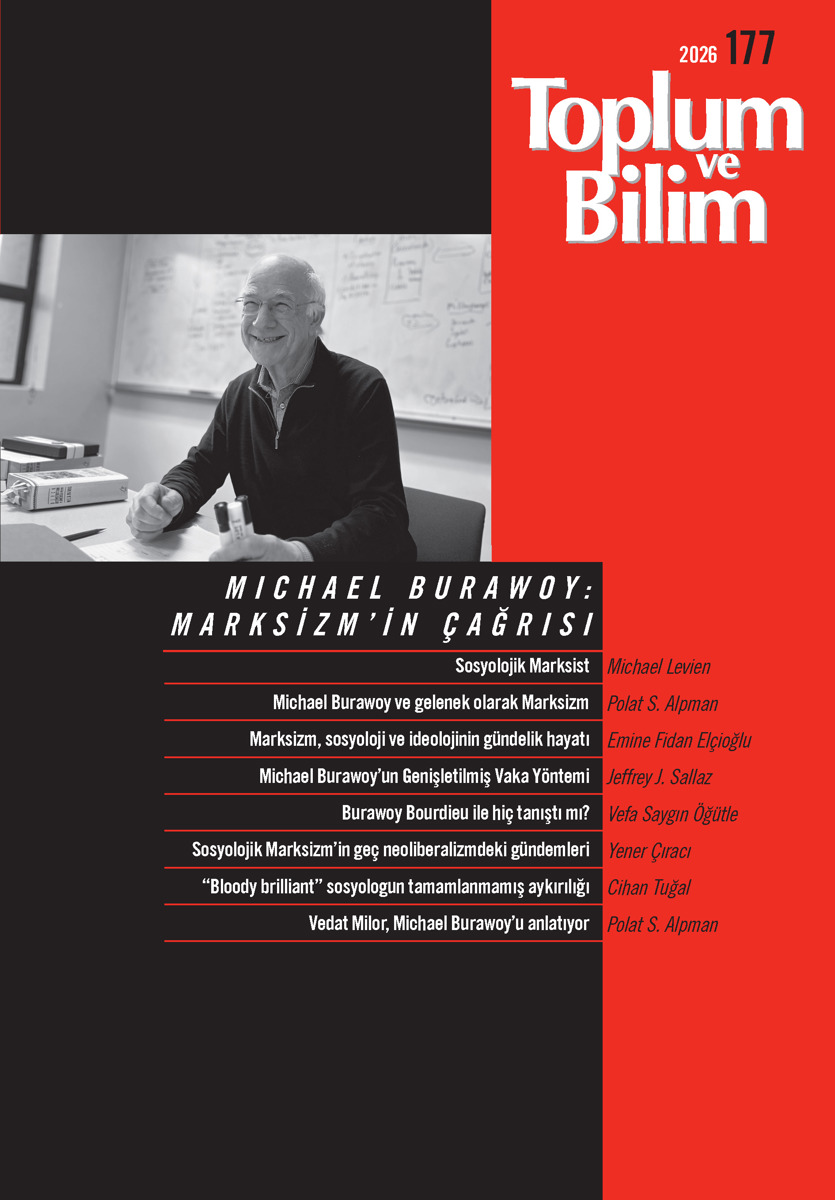
The Sociological Marxist
MIKE LEVIEN
Michael Burawoy developed his sociological Marxism through a sustained effort to connect theoretical reconstruction with empirically grounded research. At the center of this project were three fundamental premises: the primacy of society, the need for micro foundations, and theoretical reconstruction. The extended case method translates these premises into research practice by linking the microprocesses of everyday life to broader historical and social forces and by treating empirical anomalies as points of departure for theoretical reconstruction. Burawoy’s research in Zambia, Chicago, and Hungary developed this approach at the point of production and enabled comparisons among different production regimes under capitalism and state socialism. The post-socialist transformation in Russia, however, called into question the privileged position of the point of production and redirected Burawoy’s attention toward exchange and civil society. This shift was further developed through his dialogue with Polanyi around commodification and counter movements, his engagement with Bourdieu over hegemony, misrecognition, and mystification, and his work on Du Bois and Fanon concerning the relations among race, class, and capitalism. Burawoy’s sociological Marxism thus took shape as an understanding of Marxism that expanded from the ethnographic study of production relations toward questions of civil society, commodification, and racial domination, while continually revising its theoretical tools in response to different historical experiences.
Keywords: Sociological Marxism, micro foundations, reconstruction, production regimes, civil society
Michael Burawoy and Marxism as a tradition
POLAT S. ALPMAN
This article examines Michael Burawoy’s approach to the epistemic status of Marxism by focusing on the relationship between his conception of the scientific research program and his understanding of Marxism as a theoretical tradition. Criticizing conceptions of science that reduce the scientific status of Marxism to the truth of individual theories or to criteria external to theory, Burawoy evaluates Marxism in terms of its capacity to generate new theoretical and empirical content in response to historical anomalies. His critical dialogue with Popper, Kuhn, and especially Lakatos makes it possible to understand scientific development through research programs that evolve over time. Burawoy, however, reconstructs Lakatos’s model in accordance with the specific features of the social sciences and the Marxist tradition. He treats the hard core as a shared problematic of different branches of Marxism, relates theoretical development to historical tests, and argues that scientific progress cannot be entirely separated from social, political, and moral commitments. His engagements with Gouldner and Wright, in turn, establish the tension between scientific explanation and critical engagement as one of the constitutive features of Marxism. The conception of a living tradition that he developed after the collapse of state socialism further expands this epistemic framework. His theoretical encounters, extending from his engagements with Gramsci and Polanyi to his discussion of Black Marxism through Du Bois and Fanon, provide examples of the reconstruction of the Marxist problematic under changing historical conditions. Within this framework, Burawoy’s Marxism emerges as an epistemic approach that preserves theoretical commitment while making historical experience a source of theoretical reconstruction and brings scientific explanation and critical engagement together within the same research practice.
Keywords: Marxism, research program, reconstruction, science, critique
Michael Burawoy: Marxism, sociology, and the everyday life of ideology
EMİNE FİDAN ELÇİOĞLU
The production of ideology in everyday life provides a connecting thread across Michael Burawoy’s work, from his factory ethnographies to his reflections on the neoliberal university, pedagogy, the sociological canon, land, labor, and colonialism. This article traces that thread through the dialectical relationship Burawoy forged between sociology and Marxism. For Burawoy, domination is neither simply imposed from above nor fully internalized by social actors. Rather, it is continually reproduced through labor practices, institutional arrangements, and everyday interactions. Factories, universities, and classrooms therefore appear not only as sites where existing inequalities are naturalized, but also as terrains in which critical consciousness and alternative social relations may emerge. The article situates Burawoy’s reflexive ethnography, dialogical pedagogy, and critical engagements with Marx, Gramsci, Polanyi, Bourdieu, Du Bois, and Fanon within this shared problematic. It concludes that Burawoy’s sociological Marxism constitutes an approach to sociology that refuses to separate empirical inquiry from theory and critique, examining both the everyday production of domination and the contradictions through which existing social arrangements may be contested and transformed.
Keywords: Sociological Marxism, ideology, ethnography, domination, pedagogy
A Manifesto for ethnography: Michael Burawoy’s Extended Case Method
JEFFREY J. SALLAZ
In this article I offer a comprehensive introduction to Michael Burawoy’s extended case method, arguing that it represents his most enduring contribution to sociology. Rooted in the Manchester School’s situational analysis and refined through decades of fieldwork and pedagogy, the extended case method rests on a model of reflexive science that stands in deliberate contrast to positive, positivist approaches to qualitative inquiry. The article outlines the method’s four core principles –intervention, process, structuration, and theoretical reconstruction– and illustrates each through the author’s own ethnographic research in the casino resort industry in post-apartheid South Africa. Drawing on labor process theory and Burawoy’s earlier work on Zambianization, the study reveals how Black Economic Empowerment policies paradoxically reproduced colonial-era labor regimes. The article concludes by tracing how Burawoy extended his methodology in later work toward ethnographies of commodification, situating the extended case method as an enduringly versatile tool for critical social science.
Keywords: Extended Case Method, sociology, Michael Burawoy, labor process, casino resort industry
Did Burawoy ever meet Bourdieu?
VEFA SAYGIN ÖĞÜTLE
This article critically examines Michael Burawoy’s theoretical encounter with Pierre Bourdieu, focusing particularly on the concepts of class, domination, symbolic domination, and intellectual autonomy. The discussion begins with Dylan Riley’s critique of Bourdieu and Burawoy’s response to this critique, thereby demonstrating that Burawoy’s approach to Bourdieu is not simply one of rejection but rather a strategy of selective critique and appropriation. While Burawoy acknowledges the empirical strength of Bourdieu’s sociology in explaining class, reproduction, and relations of domination, he argues that Bourdieu is insufficiently capable of conceiving capitalism as a historical totality and of explaining class struggle as a constitutive dynamic of social change. The second major axis of Burawoy’s critique concerns the unconscious character of symbolic domination and Bourdieu’s emphasis on intellectual autonomy. Against these two lines of criticism, the article advances two central theses. First, there is no direct causal relationship between class exploitation and class domination: exploitation is an economic relation operating within the production process, whereas domination is a multidimensional social relation constituted through authority, legitimacy, recognition, and symbolic violence. Class domination must therefore be explained through cultural, institutional, and symbolic mechanisms that cannot be reduced to exploitation. Second, the
fact that intellectual autonomy is historically a product of bourgeois society does not mean that it should be abandoned. On the contrary, autonomy should be defended as a normative condition of critical knowledge production and of the interrogation of relations of domination, as well as a site of struggle. From this perspective, the article interprets Burawoy’s relationship with Bourdieu not merely as a selective appropriation of sociological concepts, but as an expression of epistemological struggles over position within the field of sociology. It concludes that when the relational coherence among Bourdieu’s concepts of field, habitus, and symbolic domination is overlooked, the distinctiveness of his theoretical intervention is diminished and the epistemological superiority of Marxist theory is implicitly presupposed. Nevertheless, Burawoy’s insistence on an empirically oriented, self-reflexive sociology opens the door wide to alternative dialogues between Bourdieu and the search for a Marxist sociology.
Keywords: Michael Burawoy, Pierre Bourdieu, class domination, exploitation, symbolic domination, intellectual autonomy, habitus, field, Marxism, public sociology
Michael Burawoy and the agenda of Sociological Marxism in late neoliberalism
YENER ÇIRACI
This study aims to extend Michael Burawoy’s Sociological Marxism through the new problems generated by the 2008 financial crisis and the subsequent global wave of uprisings. The framework Burawoy developed through the convergence of Gramsci and Polanyi, centered on civil society and the war of position, provides a strong analytical and normative basis for conceptualizing social transformation in the post-communist age. Yet this framework leaves unresolved the problem of class as a political force after the post-2010 uprisings, which may be described as unexpected wars of maneuver. In their aftermath, states actively fragmented civil-society positions and their class bases. To address this gap, I discuss the new agendas of Sociological Marxism by drawing on the analyses of class formation developed by E. P. Thompson and Adam Przeworski. In this way, I extend Sociological Marxism through a class analysis that moves from Polanyi to Thompson and from Gramsci to Przeworski, and I offer a framework for conceptualizing both the sources of class mobilization and the processes of demobilization and fragmentation.
Keywords: Sociological Marxism, Michael Burawoy, class analysis, class formation
The “bloody brilliant” sociologist’s unfinalized heresy: Resolving Michael Burawoy’s tensions to reconstruct the social sciences
CİHAN TUĞAL
Through workplace ethnographies on three continents, as well as methodological and theoretical interventions, Burawoy transformed the social sciences. In his last years, he wrote extensively on race and colonialism. He also encouraged his students to apply the lessons of his earlier work to labor in education. These strands of his scholarship sat uneasily alongside one another, and he did not develop an explicit framework to resolve the apparent contradictions between, and within, them. The unfinalized tensions in Burawoy’s late work lay the groundwork for a reconstructed scientific practice.
Keywords: Marxism, colonialism, capitalism
ABSTRACT (İngilizce Özetler)
ABSTRACT (İngilizce Özetler)